The Story of EO
– Ken Freeze
I actually liked this color. I didn’t buy one for a couple reasons, 1) Donna didn’t like the color and 2) I was very happy where I was in the 1995 Laguna Blue car. If I hade bought one, it would have had a black interior, light colored cars with light colored interiors have a lack of contrast. For some reason I’m OK with dark cars with dark interiors, but with dark colored cars, I would still prefer a lighter colored interior.
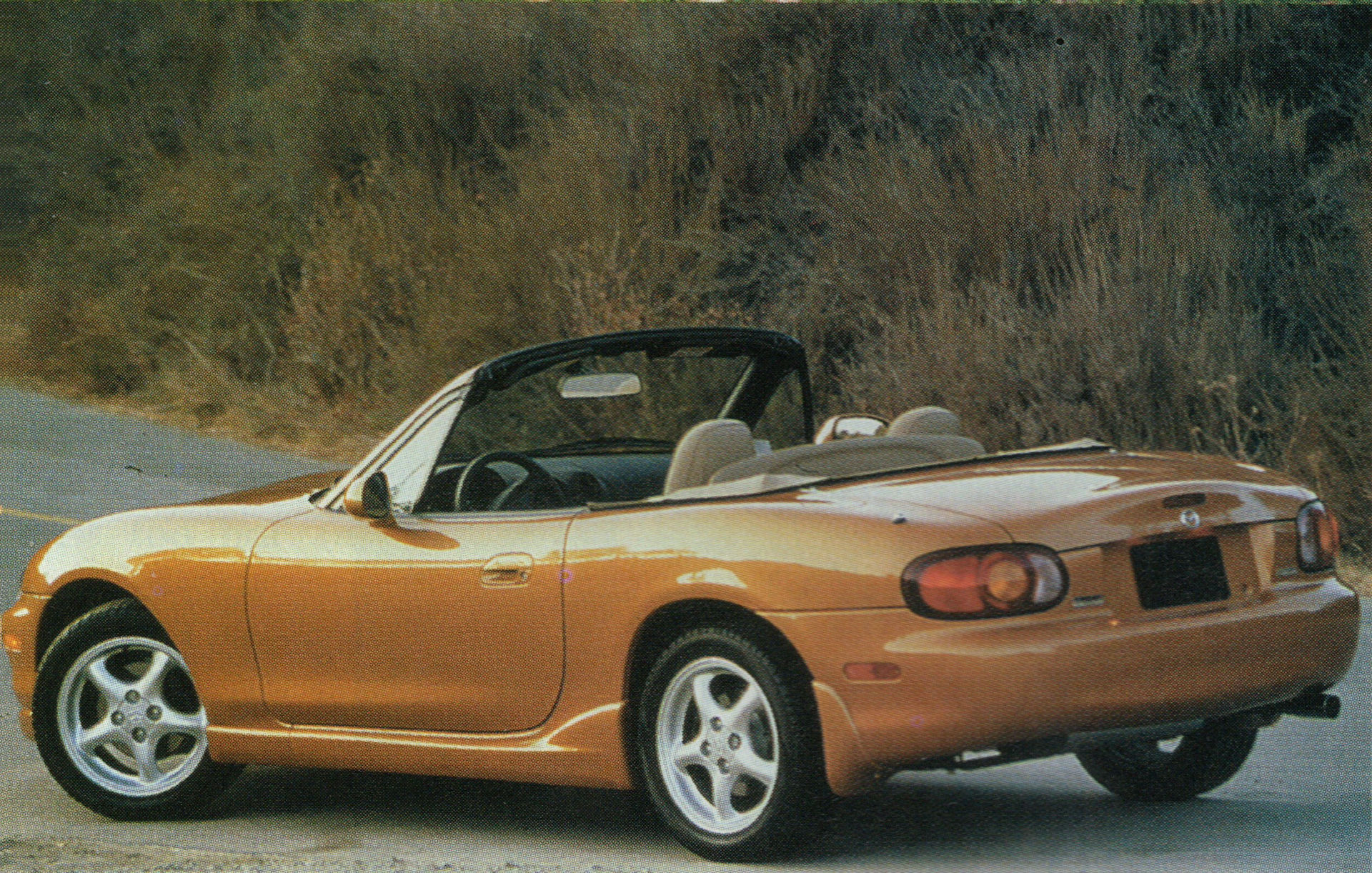
In 1998 when the second-generation Miata was introduced, it also saw the introduction of a new and striking color. While I absent from the North American market, the new color was seen in ads, web sites and brochures around the world. The color carried different names like Copper Mica, Evolution Orange, Mélange Gold and Evolution Gold depending on where the Miata was being marketed.
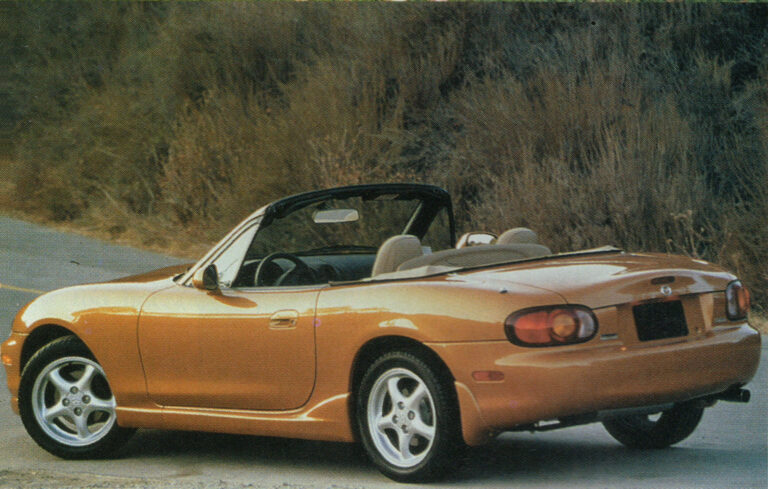
2000 Evolution Orange Miata
For the 2000 model year, Mazda introduced the color into the North American market as Evolution Orange. And just as is had in other parts of the world, the color turned heads everywhere it was seen.
Then almost as suddenly as it appeared, it was discounted worldwide, creating what is by far the shortest color run in the entire history of the Miata. For 2000 only 644 Miatas were imported and just two 1999 models were shipped into the U.S. Worldwide, the number is not much greater. It is conceivable that worldwide there are less than 1,000 Evolution Orange Miatas total for both years. Numbers between 700 to 800 total have been voiced.
How could a color that was turning up seemly everywhere go out of production so soon? Simple – it was planned that way. “The intent was to only offer the color in the U.S. for one year.” said Product Marketing Plans Manager, Mazda North American Operations, Alan Childers. “Expectations were that although the color is an eye catcher, it never would be a big seller,” he said. “But it is a flashy color that really draws attention.” And, while the color may be a ‘head turner’ and get people into showrooms, in the end they generally bought a different color.
Childers said that the Evolution Orange was just a standard color with all the regular options and packages that could be ordered by dealers. The dealers placed their orders through their regional offices and the orders were sent to Japan for production. So, the end production number reflects the orders that were placed for it.
“In 1992, the Sunburst Yellow (of which only 1,519 were sold in the U.S.) had a planned production run of around 1,500 units from the beginning of the year, ” said Childers. The Sunburst Yellow Miatas were then sent to dealers along with all the other colors available that year.
Mazda obviously saw the PR value of such a striking color. In 1999, when the 500,000th Miata rolled off the assembly line it was Evolution Orange and the 2000 press car from Mazda North America was an Evolution Orange. The press car was the Miata whose photo appeared in the 2000 Miata press kit and was the Miata loaned to just about every major auto publication in the U.S. As a result, from late 1999 through most of 2000 hardly a word was written about the Miata that didn’t also include a photo of an Evolution Orange Miata. As a result, it was easy to get the impression Evolution Orange Miatas were everywhere.
In a very real sense, there isn’t anything special about the EO’s except their color. Unlike the M-Editions or the recent 10th Anniversary model, they are not all equipped alike or include any special equipment not available on other models. They were available with a wide variety of options and packages, from stripped down base models to fully loaded LS models. But what that has done is create even rarer sub sets. For instance, the number of LS models with tan interior vs. base models with black interior. It is conceivable that there may be several one-of-a-kind Evolution Orange Miatas running around America.
Like many of the other limited and special edition Miatas, a registry has been set up on an Internet Web site to follow the Evolution Oranges and to help owners get in contact with one another. The site is http://www.allroadster.com/libs/EORegister.htm gone. Besides owners being able to register their EO Miata, the site also has facts and statistical information as well as an Evolution Orange screen saver from Mazda New Zealand.
What is in store for this rare color is anyone’s guess at this point. It’s closest counterpart, the 1992 Sunbursts Yellow, has taken on almost a cult following, with used models selling for well above the value of their used siblings from the same year.
Will models with different packages become even more sought after? Leather interior vs. black interior, suspension package vs. appearance. And, what about the Evolution Oranges with automatics? Rumor has it that very few were produced worldwide. Could this be the model most sought after by collectors and museums 50 years from now? Only time will tell.
Copyright 2000, Miata Magazine. Reprinted without permission.